
What Is Zardozi Embroidery? The Craft Behind the Price Tag
Two to three months of someone's hands. Four hours of your evening. Eleven years in a closet.
Published /Updated
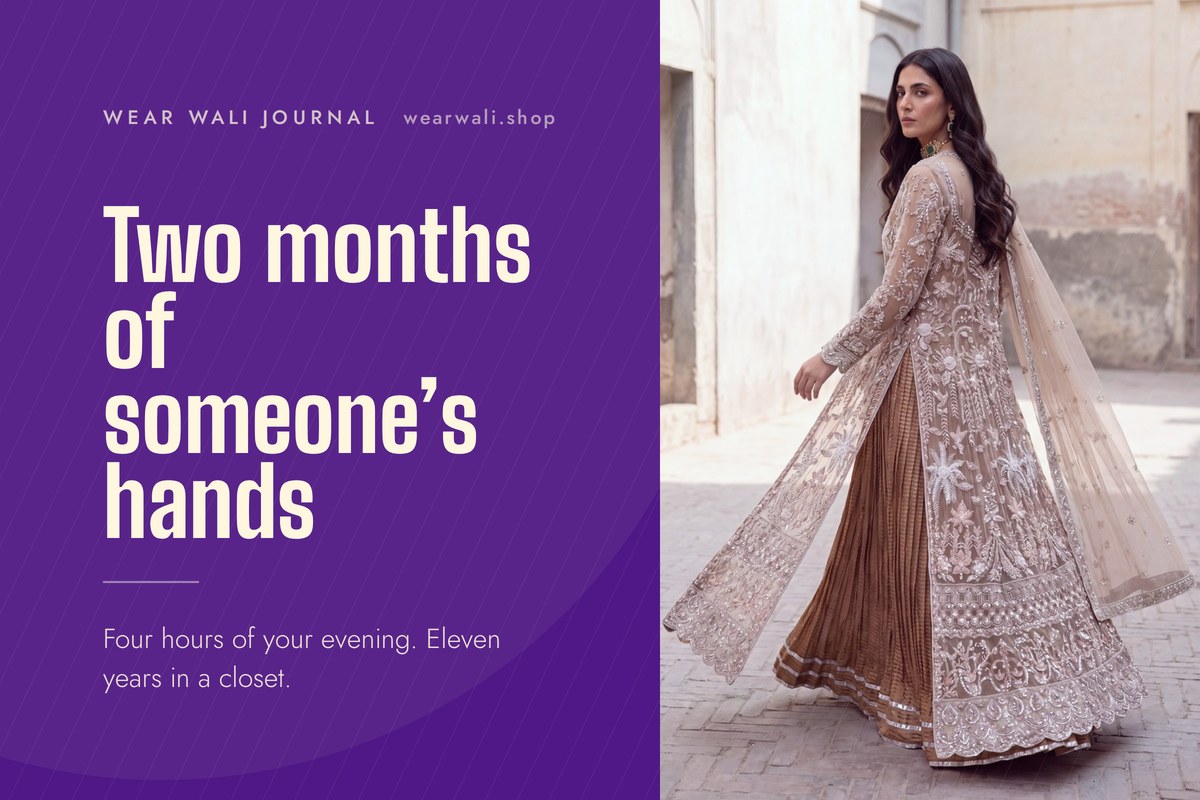
Zardozi is a hand embroidery technique that stitches metal thread, wire coils, sequins and stones onto fabric stretched across a wooden frame, using a hooked needle called an aari. It originated in Persia, took its present form in Mughal India, and it is the single largest reason a hand-worked lehenga costs several thousand dollars rather than several hundred.
The word is Persian: zar meaning gold, dozi meaning embroidery. Historically it was exactly that, real gold and silver wire couched onto silk and velvet for court dress. Modern zardozi uses gilded copper wire, plated alloys and synthetic metallic thread, which is why an outfit today weighs a fraction of what an equivalent piece weighed three hundred years ago and still does not weigh nothing.
How it is actually made
The fabric is stretched drum-tight across a wooden frame called an adda. Several artisans sit along one frame and work the same panel at once. The design is transferred by pouncing chalk through a perforated paper tracing.
Then the work begins, and it is slow. The aari needle is a fine hook, held above the fabric, that pulls thread up from below in a chain stitch. The artisan cannot see the underside. Metal elements go on individually: dabka and nakshi, tightly coiled wire cut into short lengths and threaded like beads; sitara sequins; kundan stones set in place.
A single heavily worked bridal panel can take one artisan several weeks. A full bridal set, worked by a team, routinely takes two to three months.
The part nobody says out loud
Sit with that number for a second.
Two to three months. Not machine hours. Human hours, belonging to specific people, most of whom will never be named on the garment, will never see it worn, and are paid a fraction of what it retails for. That is a separate conversation and an uncomfortable one, and it is not solved by anything on this page.
But here is the part that is within your control. That garment, representing that many months, is bought for one event. It is worn for four hours. It is then folded along an embroidered line, put in a plastic garment bag, and left in a closet where the metal thread slowly abrades against itself and tarnishes at the fold. Six years later the dupatta has yellowed and the piece is no longer wearable at the level it was made for.
Nobody intends this. It is just what happens when a garment that was designed to be used is treated as a trophy.
The environmental framing of this is the boring one, and it is also the one that never changes anybody's behavior. The interesting framing is about respect for the maker. If something took three months of a person's hands, the thing that honors that work is not preserving it untouched. It is wearing it, repeatedly, and keeping it in a condition where it can keep being worn.
Which is, incidentally, exactly what a rental garment's life looks like: worn several times a year, cleaned by specialists between wears, stored properly because storing it properly is somebody's actual job. The piece stays alive. Compare that with the honest fate of most bought pieces, and it becomes harder to argue that ownership is the more reverent option.
How to tell hand zardozi from machine work
You do not need to be an expert. Three checks:
- Turn it over. Hand aari work leaves a chain stitch on the reverse and secured, knotted thread ends. Machine embroidery leaves a dense, uniform bobbin pattern and often a backing material.
- Look for asymmetry. Two mirrored motifs on a hand-worked garment will differ slightly. On machine work they are identical, because they came from the same file.
- Feel the surface. Raised, three-dimensional coil work that sits proud of the fabric is characteristic of hand zardozi. Machine work is comparatively flat, though good machine work gets closer every year.
Why it changes how you handle the garment
Metal thread does not behave like fabric. It snags on jewelry, on bag hardware, on chair backs and on other people's embroidery in a crowd. It abrades against itself if folded along the same line repeatedly. And it tarnishes, particularly with skin contact and perfume.
Four rules:
- Never fold along an embroidered line. Roll the piece, or fold so plain fabric takes the crease.
- Perfume and hairspray go on before the outfit, not after. Alcohol dulls metallic finish permanently.
- Store with acid-free tissue between layers. Not plastic, which traps moisture against metal.
- Never machine wash and never hand wash. Water and metal thread are not compatible. Spot cleaning and professional specialist cleaning only.
If that feels like more custodial responsibility than you want for something you will wear twice, that is a reasonable conclusion, and it is a large part of why rental works in this category specifically.
The question
If something took three months to make and you wear it for four hours, what would actually count as treating it well?
Questions people ask
What does zardozi mean?
It comes from Persian, zar meaning gold and dozi meaning embroidery. It refers to metal-thread hand embroidery.
Is zardozi real gold?
Historically yes, real gold and silver wire. Modern zardozi uses gilded copper, plated alloys and metallic synthetic thread.
How long does zardozi take to make?
A heavily worked bridal set typically takes a team of artisans two to three months. A single panel can take one artisan several weeks.
Can zardozi be washed?
No. Metal thread should never be machine washed or hand washed. Spot cleaning and professional specialist cleaning only.
How can I tell hand zardozi from machine embroidery?
Check the reverse for a chain stitch and knotted thread ends, look for slight asymmetry between mirrored motifs, and feel whether the coil work sits raised off the fabric.