
What Is a Lehenga? A Complete Guide
Plot twist: the lehenga is just the skirt. Everyone has been using the word wrong for years, including, until recently, us.
Published /Updated
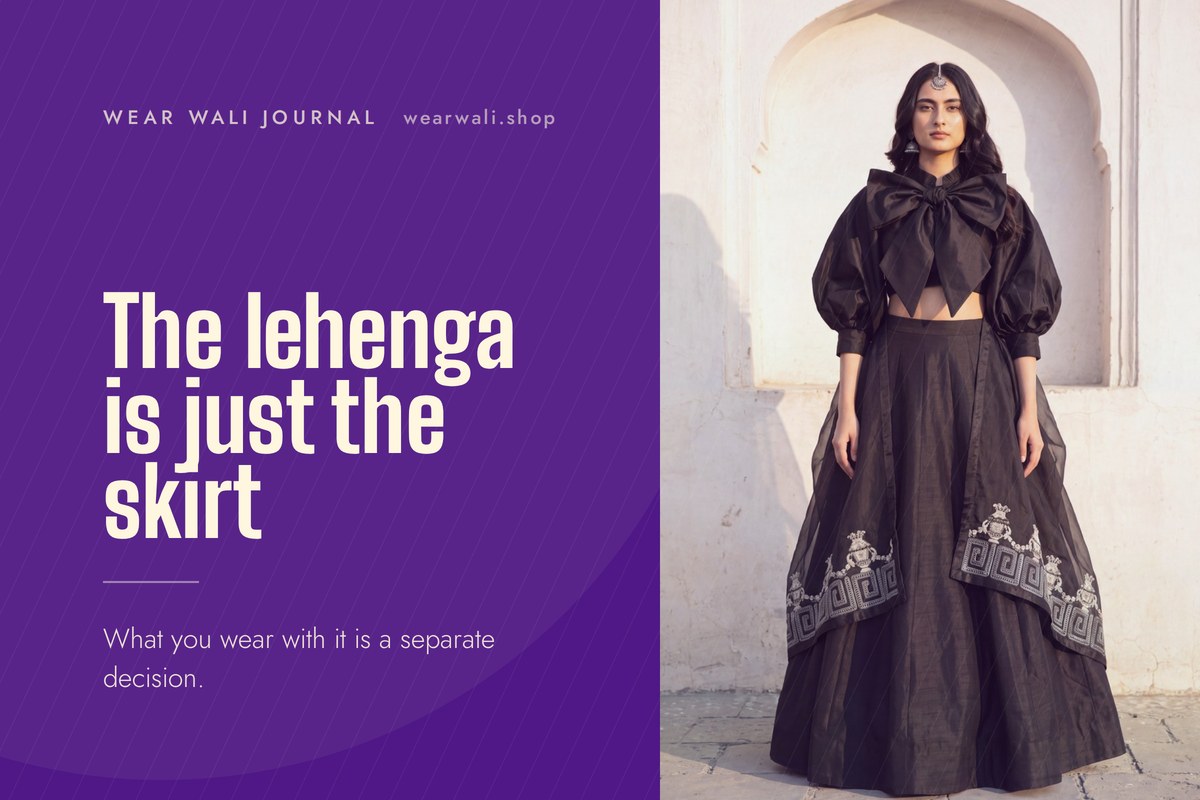
A lehenga is a long, flared skirt worn in South Asian occasion wear. It is one garment, not an outfit. The complete look, usually called a lehenga choli or a lehenga set, is the skirt plus a top and usually a dupatta, which is a long draped scarf. The top can be a fitted cropped choli, a longer kurti, a full-length shirt, a peplum or a jacket, and swapping it changes the entire look while the skirt stays the same. A new designer lehenga set typically costs $600 to $3,000 in the US and Canada.
Let us clear something up immediately, because it trips up almost everybody, including people who have been going to these weddings their entire lives.
The lehenga is the skirt.
That is the whole word. It does not mean the outfit. It does not include the top. It does not include the dupatta. When someone says "I'm wearing a lehenga," what they technically mean is "I'm wearing a lehenga and something on top and probably a dupatta," and everyone lets it slide because language is a democracy and the vote was taken years ago.
But once you know it, a lot of things stop being confusing. Chiefly this: why two outfits described with the same word can look completely unrelated.
So what actually goes on top
Here is the part that makes lehengas genuinely fun, and the part most guides skip because they are busy calling it a three-piece outfit.
The skirt is the constant. The top is the variable. Same skirt, five different tops, five different outfits.
- A choli. The classic. Fitted, usually cropped, sleeve length and neckline entirely up to you. This is the one people picture, and it is one option out of many.
- A kurti or a short kurta. A longer top, hitting anywhere from the hip to mid-thigh. Reads more relaxed, more modest, and it is a very good answer if a cropped top is not your thing for any reason at all.
- A full-length shirt or kameez. Floor-skimming or close to it, worn over the skirt so only the flare shows at the hem. Dramatic, elegant, extremely underrated, and increasingly the thing you see on people who are done with cropped tops.
- A peplum. Fitted through the torso then flaring at the waist. Structured, a bit modern, and it does a lot of the work that shapewear otherwise would.
- A jacket, cape or shrug. Layered over any of the above. Excellent if the venue is cold, which is every hotel ballroom ever built.
And then there is the skirt itself, which also has opinions:
- A-line. Narrow at the waist, gentle flare. Easiest to walk in, easiest to sit in, hardest to get wrong.
- Circular or panelled. Twenty-plus panels, huge sweep, the one from the bridal photos. Also the one that weighs eight to twelve pounds once the embroidery is on.
- Mermaid or fishtail. Fitted to the knee, flaring below. Very good standing up. Ask yourself honestly how much dancing you plan to do.
- Straight or pencil. Barely flared, sleek, modern. Popular for receptions and for people who do not want to fill a doorway.
The dupatta is the third decision and it is the sneakiest one. Over one shoulder reads formal and structured. Pinned and swept across the front reads traditional. Over the head reads bridal or ceremonial. Two dupattas is a common bridal setup. Changing how you drape it changes the outfit more than changing your jewelry does, and it costs nothing.
If you are not desi and you just got invited to one of these
Welcome. Genuinely. A few things nobody will tell you, because everyone assumes you already know.
You are not going to offend anybody by wearing one. This is the fear that keeps people in a safe black dress, and it is misplaced. South Asian weddings are, culturally, about the guests showing up looking spectacular. Turning up in something beautiful is read as effort and respect, not as costume. The family will be delighted. Somebody's aunt will want a photo with you.
Do not wear red to the wedding ceremony. In most Indian and Pakistani traditions, red or deep maroon is the bride's territory. Same instinct as not wearing white to a Western wedding. Everything else on the color wheel is open.
"Wedding" is not one event. You have possibly been invited to two, three or four functions across several days: a mehndi, a sangeet, a nikkah or ceremony, a reception, a walima. Ask which ones you are invited to and roughly how formal each is. Nobody minds this question. Everybody minds a guest who quietly guesses wrong.
It is one event and you are not going to do this again. So the arithmetic of buying a $1,400 outfit is, frankly, terrible for you. This is exactly what rental is for.
Practical: wear shoes you can slip off, because you may be asked to at a ceremony. Bring safety pins. And accept immediately that somebody will re-drape your dupatta for you at some point in the evening without asking. Let them. They are helping and they are right.
If you are desi and you are quietly pretending you knew the skirt thing
You are among friends. A significant number of us grew up in Houston or Toronto or Chicago with the clothes but not the vocabulary, because the vocabulary lived in a household language, or with a grandmother, or in a city nobody in the family lives in anymore.
Not knowing the word is not a failure of authenticity. It is just what happens when a culture travels. The clothes came with us. The glossary was harder to pack.
What it actually costs
A new designer lehenga set runs $600 to $3,000 in the US and Canada, higher for bridal with real hand embroidery. The money sits in two places: the base fabric, and the weight and type of the embroidery. Machine-worked georgette is the floor. Hand-worked zardozi on raw silk is the ceiling, and it takes a team of artisans weeks to months, which is exactly why it costs what it costs.
Renting from Wear Wali starts at $49 for a 4-day rental period, with Premium at $99 and Luxury at $159.
And here is the part worth sitting with for a second. Ask an older relative how many times she wore her good lehenga. The honest answer is usually "for about fifteen years, at everything." Ask yourself how many times you have worn yours. We have somehow ended up with the most expensive wardrobes and the least-used ones in the history of these clothes, which is a strange achievement.
How to choose one, in four moves
- Start with the event, not the outfit. A mehndi wants color, movement and a skirt you can dance in. A reception wants structure and weight. A nikkah usually wants more coverage and a quieter palette. Daytime wants less mirror work than the same outfit would carry at night, because flash photography and heavy sequins are enemies.
- Pick the top second. It is the piece that decides how the outfit reads and the piece most likely to need altering.
- Check the weight. Seriously. Ask. Eight to twelve pounds is a long evening.
- Then worry about the dupatta. It is the cheapest way to change everything.
The question
What is the highest number of times you have worn one outfit, and what did it take for you to stop caring that people had seen it?
Questions people ask
Is a lehenga the skirt or the whole outfit?
The lehenga is the skirt. The complete look is usually called a lehenga choli or a lehenga set: the skirt, a top, and usually a dupatta.
What can you wear on top of a lehenga?
A fitted cropped choli, a longer kurti, a full-length shirt or kameez, a peplum top, or a jacket or cape layered over any of them. The top is a separate choice from the skirt.
Is a lehenga the same as a sari?
No. A lehenga is a stitched skirt. A sari is a single unstitched length of fabric, five to nine yards, wrapped and pleated around the body over a petticoat and blouse.
How much does a lehenga cost?
A new designer lehenga set typically costs $600 to $3,000 in the US and Canada, with bridal pieces higher. Renting one from Wear Wali starts at $49 for a 4-day rental period.
Can a non-South Asian guest wear a lehenga to an Indian or Pakistani wedding?
Yes, and it is generally welcomed as a sign of effort and respect. Avoid red or deep maroon at the wedding ceremony itself, since that is traditionally the bride's color.
How heavy is a lehenga?
A light georgette skirt can weigh under three pounds. A fully embroidered bridal lehenga can reach eight to twelve pounds. Worth asking before a long event.
Can you rent a lehenga in the United States?
Yes. Wear Wali rents South Asian occasion wear across the US and Canada, shipped to your door with a prepaid return label.