
How Rental Outfits Are Cleaned and Checked Between Wearers
Every rental company says its outfits are professionally cleaned. Almost none will tell you who decides that a garment is clean enough to send out again.
Published /Updated
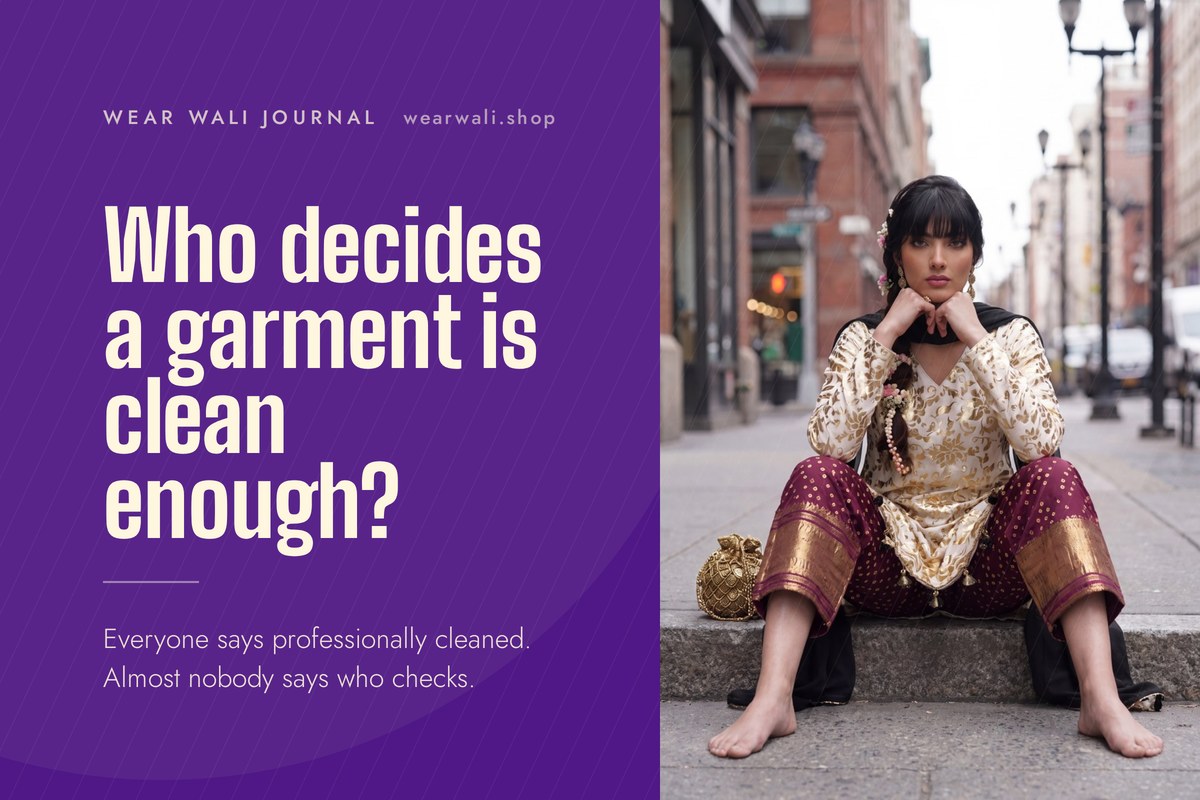
Every Wear Wali outfit is professionally cleaned and UV sanitized after every single rental. Each piece is photographed against a numbered garment tag before it ships, every returned parcel is opened on camera in one continuous unedited take, and every return is inspected within 48 hours of being collected from the return point. A piece that cannot be brought back to standard is retired from the catalog.
The hygiene question is the first one people ask about rental and the last one most rental companies answer properly. Usually you get one sentence: professionally cleaned between rentals. That sentence is doing an enormous amount of unexamined work.
Here is the actual process, in order.
Before it ships to you
Every garment is photographed before the shipping label is printed, never after, with its numbered garment tag in the frame. Pre-existing wear is photographed honestly rather than hidden, because a record that only shows an outfit at its best is not a record anybody can rely on, including you.
That matters to you for one specific reason: the condition of the outfit when it left is documented, so nothing that was already there becomes your problem.
The cleaning
Every piece goes to a licensed commercial cleaner after every single rental. Not a selection of pieces. Not the ones that look like they need it. Every piece, every time.
That is the expensive answer and it was chosen over the cheaper one on purpose. The cheaper way to run a rental business is to inspect a garment, decide it looks fine, steam it and send it out again. Most of this category works that way. The problem is the phrase looks fine, because it is a judgement made by somebody who has a booking to fill and a garment sitting in front of them.
The order is fixed: professional clean first, then spot treatment for anything remaining, then steam, then a UV pass as the final step. For the UV pass the garment is hung fully open, sleeves and linings opened, because UV only reaches the surfaces the light actually touches. A folded garment under a lamp is theater.
Professionally cleaned and UV sanitized after every single rental. That is the whole standard. There are no exceptions inside it, no trigger list, and no piece that skips a cycle because it looked clean.
If a piece cannot be brought back to standard, it is retired from the catalog. Not discounted. Not quietly kept in rotation for the bookings where nobody looks too closely. Retired. That is the part of the policy that costs real money, and it is the only version of this promise that means anything.
Outfits are never machine washed or hand washed. Metal-thread embroidery and water are not compatible, and a single wash cycle would permanently dull zardozi work on a piece worth several thousand dollars. That is also why you are asked not to clean anything yourself before returning it.
The part nobody says out loud
The cleaner is not named publicly, and that is a choice rather than an oversight.
Naming a partner invites the next question, which is always some version of and who checked them. There is no badge in garment cleaning that a customer could look up and verify, so putting one on a page would be a claim about a status nobody outside the business can test. What you can test is a process: what happens, in what order, to which pieces, every single time. That is written down, it is the same for every garment, and it is what you have just read.
A claim you cannot check hands the doubt straight back to the person reading it. A described process does not.
When it comes back
The return goes to a receiving point and is collected daily. Then:
- No parcel is ever opened off camera. One continuous, unedited take. The sealed box and its label appear in frame first, the booking ID and tracking number are spoken aloud, and every piece is named as it comes out.
- A 48-hour inspection clock starts at collection, not at carrier delivery. Anything missing, marked or damaged is identified against the pre-dispatch photographs of that exact numbered garment.
- Every return ships insured at the garment's full replacement value, so a parcel lost in transit is a resolved problem rather than an argument.
The reason for filming is that it protects both sides. It protects the business against a genuinely damaged return, and it protects you against being charged for something that was already there, or for something that happened in a warehouse after the box was opened. A cut in the video is exactly where a dispute would live, so there are no cuts.
What ordinary wear means
Occasion wear gets worn at occasions. Perfume, a smear of foundation on an inner collar, a loose sequin, a hook that has given up: all expected, all priced into the rental, none of it charged back.
The line is between wear and damage, and damage is assessed on evidence against the dated pre-dispatch photographs of that specific numbered garment. Nothing is assessed while a piece is still in the box and nothing is charged on assumption. The inspection happens first, the photographs are the reference, and the decision comes after both. An optional protection plan is offered at checkout, never pre-selected, and the full terms sit in the rental agreement.
What you should do
Three things, and none of them are cleaning:
- Do not attempt any cleaning or repair. Spot cleaning at home is the single most common cause of permanent damage to an embroidered garment. A mark a specialist can lift becomes a mark nobody can lift once it has been rubbed with soap and water.
- Check for every piece before you seal the box. The dupatta is the most commonly lost item in this category, and it is almost always still at the venue.
- Send it back on time. Somebody's event depends on it.
If a rental company will not tell you what happens to a garment it cannot get clean, what do you think happens to it?
Questions people ask
Are rental outfits actually clean?
Yes. Every outfit is professionally cleaned and UV sanitized after every single rental, then inspected within 48 hours of collection against dated photographs taken before it shipped.
Are rental outfits washed?
Never machine washed or hand washed. Metal-thread embroidery is damaged permanently by water, so cleaning is specialist only.
Should I clean the outfit before I return it?
No. Home spot cleaning is the most common cause of permanent damage to embroidered garments. Return it as it is.
What happens if I spill something on a rental outfit?
Return it without cleaning it and say what happened. Ordinary wear is expected and priced into the rental. Damage is assessed on evidence against the photographs taken before dispatch.
How do you know the damage was not already there?
Every garment is photographed against its numbered tag before the shipping label is printed, and every return is opened on camera in one continuous unedited take.
Is a rental outfit cleaner than one I own?
Usually, yes. A rental is professionally cleaned after every single wear. Most owned occasion wear is cleaned late, cleaned badly, or stored in a plastic dry cleaning sleeve, which traps moisture against embroidery.
What happens if an outfit cannot be cleaned properly?
It is retired from the catalog. It does not go back into rotation at a lower price.